

Twelve short reflections on mortality, attention and what we leave behind – a companion for anyone trying to make sense of the fact that their time here won’t last forever.
Written by Ken Banks, the technologist and anthropologist behind FrontlineSMS, ‘Beautifully Borrowed’ grew out of questions that his previous book, ‘The Little Book of Mindful Social Change‘, didn’t have room to answer. While that book was written for those trying to do good in the world, this one is for anyone trying to make sense of the fact that their time to do so is limited.
The idea behind the book
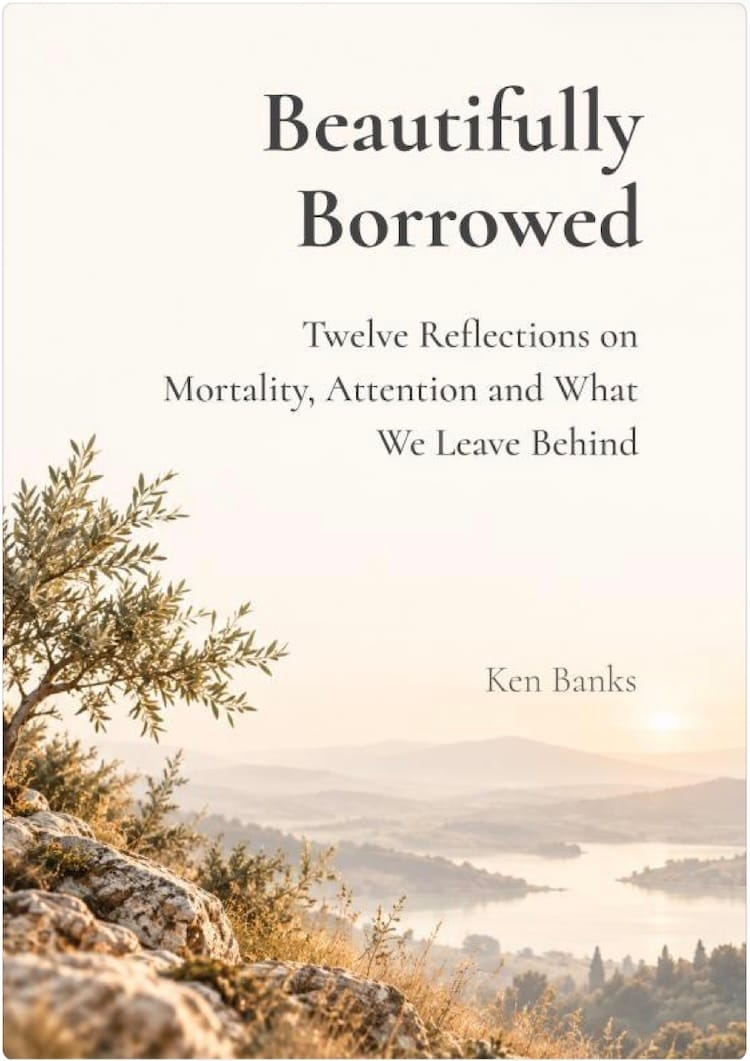
The book opens with Ken finding himself sitting in a small patch of forest in a Ugandan nature reserve, a place that would have sheltered countless people before him (and would likely shelter countless more after he’d gone). “The trees belonged to none of us” he writes, and that simple observation runs through everything that follows – that the places we love, the knowledge we carry, even our own bodies, are never really ours to keep.
Drawing on the Japanese idea of mono no aware – a gentle awareness that everything is transient, and that this transience is precisely what makes life beautiful – the book offers twelve short reflections rather than a single argument, each one built around a different way of holding a borrowed life a little more lightly. These reflections touch on everything from attention to enough, small choices, letting go, wonder and what we leave behind.
As Ken puts it, our lives are less like possessions than they are like borrowed books. We receive them carrying the fingerprints of those who came before us, jot down a few notes of our own in the margins, and one day quietly pass them into someone else’s hands. You can read more about how the book came about in the launch post, Beautifully Borrowed: A Book About Living.
Why this matters
Most of us spend our lives quietly assuming permanence. That today’s plans, relationships and even our own health will simply continue. ‘Beautifully Borrowed’ gently challenges that assumption without ever becoming morbid. Drawing on decades spent working across Africa in conservation, anthropology and humanitarian relief, Ken argues that mortality isn’t something to push out of mind, but something that, faced honestly, sharpens gratitude and clarifies what actually matters. It’s less a book about death than a book about paying proper attention to being alive.
Why this book is different
“If everything is borrowed, then perhaps the kindest way to hold it is with open hands.”
This isn’t abstract philosophy borrowed from a wellness trend. Each reflection is grounded in a specific memory. A ranger in Zimbabwe who noticed what others walked straight past, a box of old diaries that had followed Ken through several house moves without ever being unpacked, a chance conversation years after a talk he’d long forgotten giving. The book’s move throughout is to take these very ordinary moments and let them quietly reframe what it means to have, to hold – and to eventually let go.
It isn’t a manual for facing death, and it doesn’t pretend to have answers. It’s closer to a companion for the ordinary business of being alive while knowing, somewhere in the background, that none of it lasts.
What you’ll learn
- How to hold what you have – relationships, places, achievements – a little more lightly, and why that makes them easier to love
- How paying real attention to the ordinary is itself an act of care
- How to recognise when you already have enough, rather than chasing the next horizon
- How the small, quiet choices you make each day shape a life more than any single dramatic moment
- How to practise letting go without feeling that you’re losing something
- How to measure a good life by what you noticed and nurtured, not by what you accumulated
About the author
 For over 25 years Ken Banks has worked across some of the most remote parts of the developing world, particularly Africa, at the intersection of technology, conservation and humanitarian relief. He’s probably still best known as the creator of FrontlineSMS, and is the founder of kiwanja.net and apathy to action. Along the way he’s picked up a PopTech Fellowship, an Ashoka Fellowship, a National Geographic Explorer title and a handful of other prizes, including the ACM Eugene L. Lawler Award for Humanitarian Contributions within Computer Science. He’s a British social innovator, technologist and anthropologist by trade, and increasingly a writer by inclination.
Sample reflections
‘Beautifully Borrowed’ is broken down into twelve short reflections of just a few pages each, moving from a Ugandan forest to a Zimbabwean bush trail, from an unopened box of old diaries to a quiet room where today is already becoming yesterday. Here’s where each one starts:
Everything is Borrowed – Nothing truly belongs to us
The Privilege of Being Here – The ordinary is never ordinary
Attention is an Act of Love – We cannot care deeply about what we have never really noticed
Enough – Contentment begins when comparison loosens its grip
The Weight of Small Choices – Our lives are shaped less by dramatic moments than by the quiet decisions we make every day
Leave Places Better Than You Found Them – Every encounter leaves the world slightly different
You Are Not the Centre of the Story – The world becomes larger when we learn to occupy a smaller place within it
Practice Letting Go – The rhythm of life is not learning how to hold on, but learning what we can release
The Things That Outlive Us – We leave more behind than we ever realise
Live Close to Wonder – Curiosity is one of gratitude’s closest companions
Measure a Good Life Differently – The things that matter most are often the hardest to count
When Today Becomes Yesterday – Every ordinary day is already becoming a memory
HOW TO GET THE BOOK
There are a few ways you can get hold of a copy of the book. In the spirit of all of Ken’s work, a free PDF can be downloaded from this website here, and you’ll find Kindle and paperback versions on Amazon here. An audiobook will be in the works later in the year.
Also available
The Little Book of Mindful Social Change
A short, honest guide for people who want to make the world better without burning out, hardening or losing themselves (or those they seek to help) in the process.

The Pursuit of Purpose: Part Memoir, Part Study – A Book About Finding Your Way in the World
A deeply personal exploration of how one life, shaped by curiosity, compassion and unexpected turns, became a lifelong search for purpose and meaningful contribution.

Musings of a Mobile Anthropologist
Over seventy of the most thought-provoking posts from twelve years of kiwanja.net, collected in one free eBook.

Social Entrepreneurship and Innovation
The journeys of pioneering, and often accidental, social innovators in their own words, with forewords by Peter Gabriel and Bill Drayton.
The Rise of the Reluctant Innovator
A refreshingly honest look at innovation through the eyes of people who never intended to become innovators in the first place.